

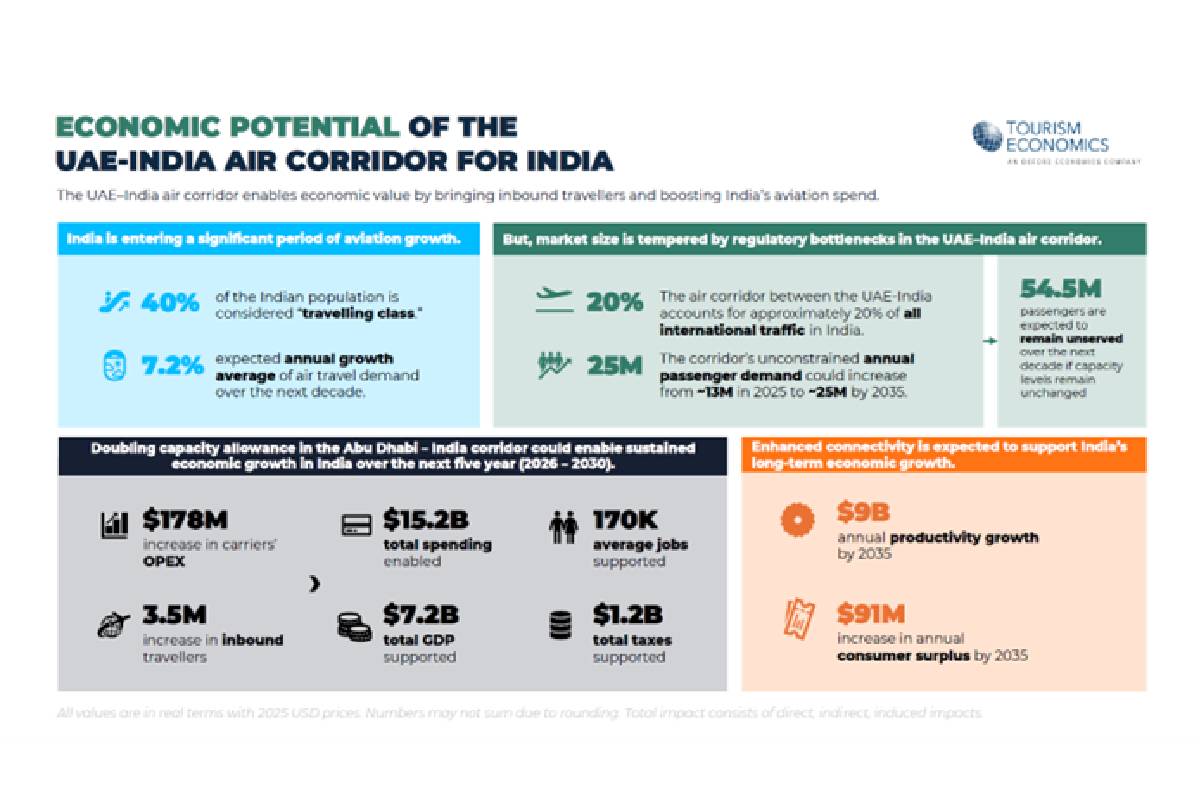

- Research finds more than a quarter of forecast demand may remain unserved without expansion, equating to 54.5 million unfulfilled passenger journeys over the next decade
A new study finds that existing limits on flight and seat capacity between India and the United Arab Emirates may not keep pace with rising travel demand, potentially reducing the economic benefits that stronger air connectivity can support.
The analysis shows that 27% of forecast passenger demand between India and the UAE could remain unserved by 2035 if capacity remains at current levels. This equates to a cumulative shortfall of approximately 54.5 million passenger journeys between 2026 and 2035, with 13.2 million unserved passengers on the Abu Dhabi–India corridor alone. This indicates particularly acute capacity constraints on the Abu Dhabi–India corridor.
The report highlights strong structural growth in India’s aviation market. India’s travelling class—households with sufficient income to travel by air—has grown from 24% of the population in 2010 to 40% in 2024, representing an increase of nearly 300 million people. As a result, air travel demand is projected to grow by 7.2% per year through 2035, adding nearly 22 million additional passenger journeys per year over the next decade.
Matthew Dass, Director of Consulting, from Tourism Economics, said: “India–UAE air travel demand is growing rapidly, underpinned by rising incomes, expanding international trade, and increasing outbound and inbound tourism. Load factors exceed 80% on major routes in the study period, indicating limited spare capacity under current schedules. In our baseline outlook, the gap between forecast demand and available seats widens over time and available capacity is expected to be exhausted by 2026. ”
The study also quantifies the economic activity enabled by the UAE–India air corridor, focusing on inbound travellers’ tourism spending and airlines’ operational expenditure along the corridor. Under continued capacity constraints, the corridor’s GDP contribution is projected to grow at a 3% CAGR over the next five years; easing constraints under alternative scenarios could lift growth to 5.5%–7%. For example, doubling Abu Dhabi–India seat capacity is expected to enable an additional of $7.2 billion in GDP (including direct, indirect, induced impacts) over the next five years and support more than 170,000 jobs per year on average.
Beyond immediate impacts, the study suggests that improved connectivity could contribute to productivity gains (up to $9 billion per year by 2035) and may support investment and trade outcomes over time. The report also notes that increased capacity and competition can place downward pressure on fares, benefiting passengers.
The report concludes that aviation policy choices will play a critical role in determining whether India is able to fully capture the economic and consumer benefits of growth in international air travel.

Comments are closed.