
Lenin Pandiyan Movie Review: Gangai Amaran Leads a Thoughtful Drama About Justice, Power and Human Dignity
D.D. Balachandran's directorial debut brings together an elderly farmer and an insecure young constable in a rural battle against corruption, delivering meaningful ideas that occasionally struggle to find their full cinematic expression.

A Small Injustice with Larger Consequences
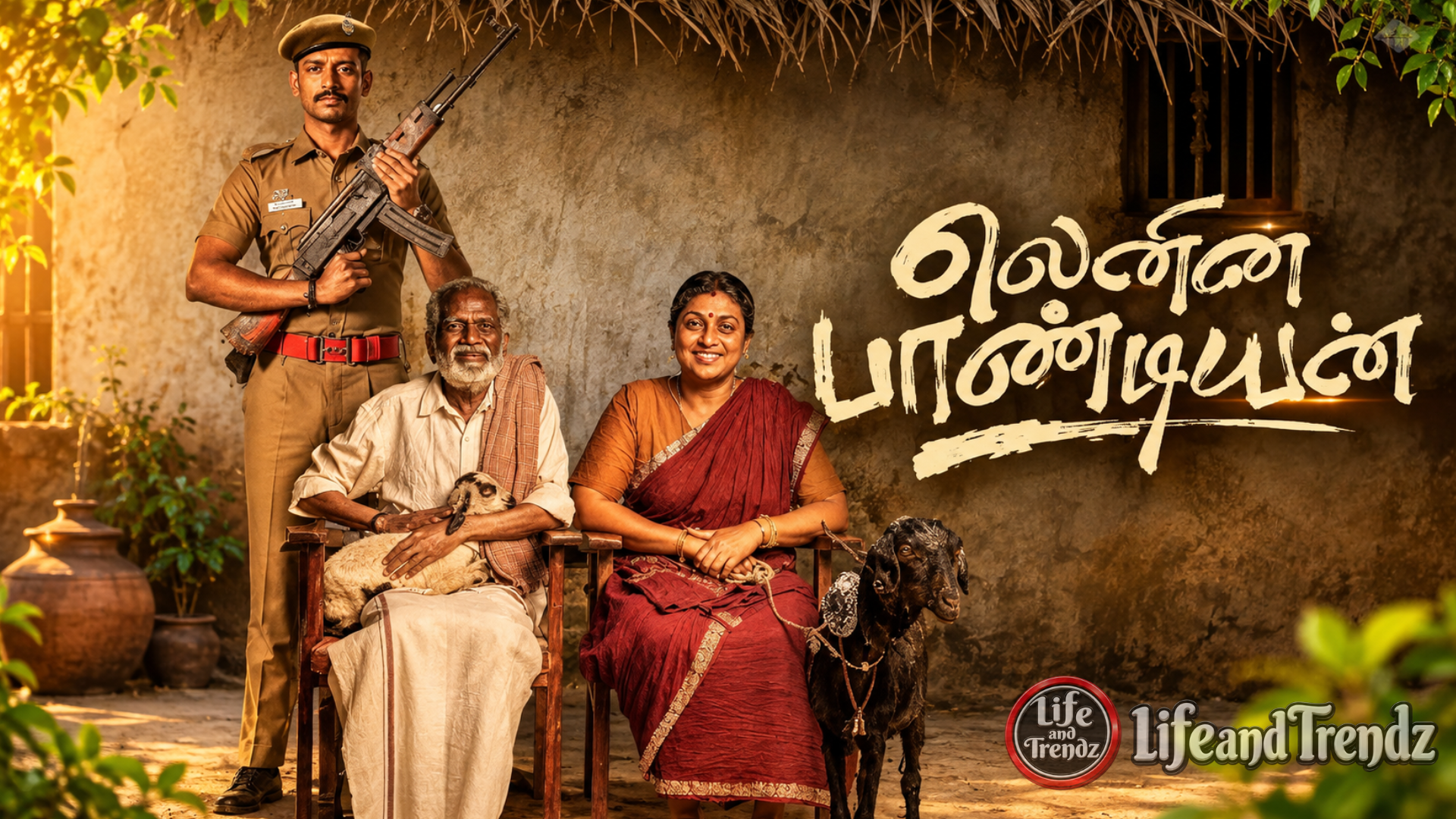
Some stories begin with extraordinary circumstances. Others find their dramatic strength in incidents that most people would consider insignificant. D.D. Balachandran’s Lenin Pandiyan belongs to the latter category. Its central conflict begins with an elderly farmer seeking justice after his beloved goat is killed by a vehicle connected to an illegal sand-mining operation. What initially appears to be a minor rural dispute gradually exposes a much larger network of political influence, institutional corruption and abuse of authority.
Released on 25 September 2026, the Tamil crime drama brings together Gangai Amaran, Roja Selvamani and debutant Dharshan Ganesan. The film also marks D.D. Balachandran’s directorial debut and Gangai Amaran’s first leading role.
There is an interesting creative ambition here. Balachandran attempts to connect the vulnerability of an elderly farmer with the insecurities of a young police constable. Both characters occupy different positions in society, yet neither possesses the confidence or institutional power needed to confront injustice independently.
The premise gives the film a meaningful foundation. Its execution, however, is considerably more uneven.
Ideology and Central Theme: Who Gets to Demand Justice?
The most interesting aspect of Lenin Pandiyan is its understanding of how society decides whose suffering deserves attention.
Durairasu’s demand for justice begins with the death of an animal. For someone looking at the incident from outside, it might appear trivial. For the farmer, the goat represents emotional attachment, everyday companionship and a part of his ordinary existence. His refusal to accept the incident quietly becomes an assertion of personal dignity.
Balachandran uses this seemingly modest conflict to examine a familiar social hierarchy. People with political connections and economic influence can often decide how much importance an ordinary person’s complaint receives. The law may promise equality, but access to justice remains complicated when the opposing side controls local power structures.
The film also introduces an interesting parallel through Maravarman Sundarapandian. Unlike Durairasu, whose struggle concerns the recognition of his rights, the young constable struggles with his own identity. His insecurity and experiences of humiliation make him an equally vulnerable figure within the system.
This creates an effective thematic connection between two generations. One man wants his dignity recognised after years of living quietly; the other wants to establish his worth in a profession that repeatedly makes him feel inadequate.
The judge Beemarao adds another dimension to this discussion. His character represents the possibility that education, legal knowledge and institutional responsibility can give an otherwise underestimated individual the authority to challenge social prejudice.
The film’s strongest argument is that dignity should not depend on appearance, financial status or social influence. It is a worthwhile idea, particularly in a story involving rural power structures and illegal sand mining.
However, the film’s determination to communicate this message sometimes becomes too visible. Its social commentary occasionally feels more carefully constructed in dialogue than fully developed through dramatic situations.
Screenplay and Direction: A Strong Foundation with an Uneven Second Half
D.D. Balachandran deserves credit for choosing a grounded premise for his first film. Rather than building the narrative around a conventional larger-than-life hero, he places ordinary people at the centre of a conflict involving powerful interests.
The screenplay’s most effective material emerges from its character relationships. Durairasu and Sandhanam provide the emotional foundation, while Maravarman’s gradual movement towards self-confidence offers the film a coming-of-age dimension.
The courtroom portions involving Beemarao are particularly important. They give the story a space where arguments about equality, dignity and justice acquire practical meaning. George Maryan’s presence helps these sequences carry conviction without relying entirely on the film’s central protagonists.
The writing also benefits from sharp dialogues that address social attitudes and administrative behaviour. The distinction between judging someone by their appearance and recognising their abilities becomes a recurring idea.
However, the screenplay struggles to maintain the same narrative discipline throughout.
The first half establishes the conflict and builds audience interest through relatively grounded situations. In the second half, the romantic subplots involving the two lead pairs interrupt the central struggle. Their emotional motivations are understandable, but the transitions do not always feel sufficiently organic.
The film also introduces several characters representing different forms of authority and wrongdoing. While this broadens the social landscape, some of these threads receive less development than their initial introduction suggests.
The final act carries the burden of resolving too many narrative concerns. As a result, the emotional impact does not fully match the strength of the initial premise.
Balachandran shows an understanding of character-based storytelling. His next challenge will be controlling the narrative more firmly, particularly when a socially ambitious screenplay begins expanding in multiple directions.
Performances: Gangai Amaran and George Maryan Provide the Emotional Strength
Gangai Amaran’s casting is one of the film’s most interesting decisions. Known primarily for his contributions to Tamil music and filmmaking, he takes on the responsibility of carrying a leading character in a full-length drama.
As Durairasu, he brings an approachable quality to the elderly farmer. The character requires a combination of innocence, stubbornness, humour and emotional vulnerability. Gangai Amaran’s performance is particularly effective in the quieter moments involving his relationship with Sandhanam and his attachment to the goat.
There are moments when the emotional expression becomes slightly excessive, but the character’s underlying warmth remains an important part of the film.
Dharshan Ganesan makes his acting debut as Maravarman Sundarapandian. His character is more complicated than a conventional young police officer. He is physically and emotionally vulnerable, frequently struggles with self-confidence and wants recognition within his profession.
Dharshan understands the character’s insecurity and gives him a reasonably convincing screen presence. His performance has promising moments, particularly when the character’s sense of responsibility begins to take precedence over personal fear. There is still room for greater control in emotional expression, but the debut shows potential.
Roja Selvamani plays Sandhanam, Durairasu’s wife, with a strong sense of character. She brings firmness and emotional maturity to the relationship. Rather than functioning merely as a supportive presence, Sandhanam has her own principles and contributes to the film’s central emotional argument.
Shrrita Rao, as Priya, provides an important emotional connection to Maravarman’s storyline. Her character has moments of determination, although the romantic track does not receive the consistent screenplay attention it needs.
The most striking supporting performance belongs to George Maryan as Judge Beemarao. He brings authority, restraint and humour to a character whose personal history gives additional meaning to his position. His courtroom sequences become some of the film’s most memorable passages.
Bose Venkat, Aadukalam Naren, Yugendran and Archana Ravichandran contribute to the wider rural and institutional setting. Archana’s character Podhum Ponnu also provides an important connection to the story’s conflict.
The ensemble is generally well selected, although several supporting characters could have benefited from greater development.
Technical Analysis: Ilaiyaraaja’s Music Strengthens the Emotional Core
Ilaiyaraaja’s contribution is among the film’s strongest creative assets. His background score understands the emotional requirements of the narrative and often allows scenes to develop without excessive musical intervention.
The music gives additional weight to the film’s quieter emotional moments. The use of the familiar Poongatru Thirumbuma from Mudhal Mariyadhai also connects with the relationship between Durairasu and Sandhanam. It functions as a deliberate musical reference to an earlier tradition of Tamil rural romance.
However, the effectiveness of such a reference ultimately depends on the scenes surrounding it. Nostalgia can establish an emotional connection, but the screenplay must still earn that response.
A.M. Edwin Sakay’s cinematography contributes significantly to the film’s rural identity. The Manamadurai and Sivagangai surroundings provide an appropriate visual environment for a story rooted in village life, local authority and the consequences of illegal sand mining.
The geographical setting is relevant to the narrative rather than functioning as a decorative background. The rural atmosphere gives the conflict a recognisable social context.
Nagooran Ramachandran’s editing keeps the initial narrative moving, although the film’s later portions could have benefited from tighter trimming. The extended final stretch and the transitions between the central conflict and romantic material affect the overall rhythm.
Production design and the film’s location-based approach support its grounded atmosphere. The visual treatment generally remains consistent with the story’s rural setting.
The technical departments work most effectively when they support the characters and their circumstances. The film does not need elaborate spectacle to establish its world.
Strengths and Weaknesses: Where Lenin Pandiyan Succeeds and Falls Short
The film’s principal strengths are its socially relevant premise, thoughtful character construction, effective courtroom writing and Ilaiyaraaja’s music. Gangai Amaran brings warmth to Durairasu, Dharshan Ganesan offers a promising debut, and George Maryan makes a strong impression as Beemarao.
Its weaknesses emerge primarily from screenplay execution. The second half loses some of the first half’s narrative focus, romantic portions interrupt the central conflict, and the final act does not deliver the emotional force suggested by the setup.
The film also occasionally explains its social arguments through dialogue when stronger dramatic situations could have communicated them more naturally.
Final Verdict: A Meaningful Debut That Needed a Tighter Screenplay
Lenin Pandiyan is an earnest Tamil social crime drama built around a simple but important question: does an ordinary person have the power to demand justice when influential people stand against them?
D.D. Balachandran establishes an interesting cinematic foundation through two vulnerable protagonists and a supporting character who gives the film’s discussion of equality additional weight.
The uneven second half prevents the film from reaching its full potential. Nevertheless, its social concerns, character-driven writing, performances and Ilaiyaraaja’s music make it worth considering for audiences who appreciate rural dramas with a meaningful subject.
Those expecting a tightly constructed crime thriller may find the narrative less satisfying. Viewers interested in stories about ordinary people, institutional responsibility and human dignity will find more to appreciate.
A sincere film with something meaningful to say, even if its screenplay does not always say it with the precision its subject deserves.
“When ordinary people demand justice, the real test is whether the system is prepared to listen.”
FAQ: Lenin Pandiyan Movie Review
1. What is Lenin Pandiyan about?
Lenin Pandiyan follows an elderly farmer and a young police constable whose lives become connected through a conflict involving illegal sand mining, corruption and abuse of power. The film explores the difficulties ordinary people face when seeking justice against influential individuals.
2. Who directed Lenin Pandiyan?
The film was written and directed by D.D. Balachandran. It marks his directorial debut. His approach combines rural storytelling, social commentary and character-driven drama.
3. Who are the lead actors in Lenin Pandiyan?
The film stars Gangai Amaran as Durairasu, Roja Selvamani as Sandhanam, Dharshan Ganesan as Maravarman Sundarapandian and Shrrita Rao as Priya. George Maryan, Bose Venkat and Aadukalam Naren appear in supporting roles.
4. How is Gangai Amaran’s performance in Lenin Pandiyan?
Gangai Amaran brings warmth, humour and emotional vulnerability to Durairasu. His portrayal of an elderly farmer seeking justice provides much of the film’s emotional foundation. His transition into a leading acting role is an interesting aspect of the film.
5. How is Dharshan Ganesan’s acting debut?
Dharshan Ganesan delivers a promising debut as a young constable struggling with insecurity and professional responsibilities. His performance has some effective moments, although greater emotional control would strengthen certain portions.
6. How is Ilaiyaraaja’s music in Lenin Pandiyan?
Ilaiyaraaja’s music supports the film’s emotional storytelling. His background score adds weight to important sequences, while the reference to Poongatru Thirumbuma from Mudhal Mariyadhai connects with the elderly couple’s relationship.
7. Is Lenin Pandiyan worth watching?
Yes, particularly for audiences interested in rural Tamil dramas, social justice themes and character-based storytelling. The uneven second half and underdeveloped romantic portions affect the overall experience, but the central performances and social message offer reasons to watch.

Comments are closed.