

A camera is built to capture images, but great camera design can become an image in itself.
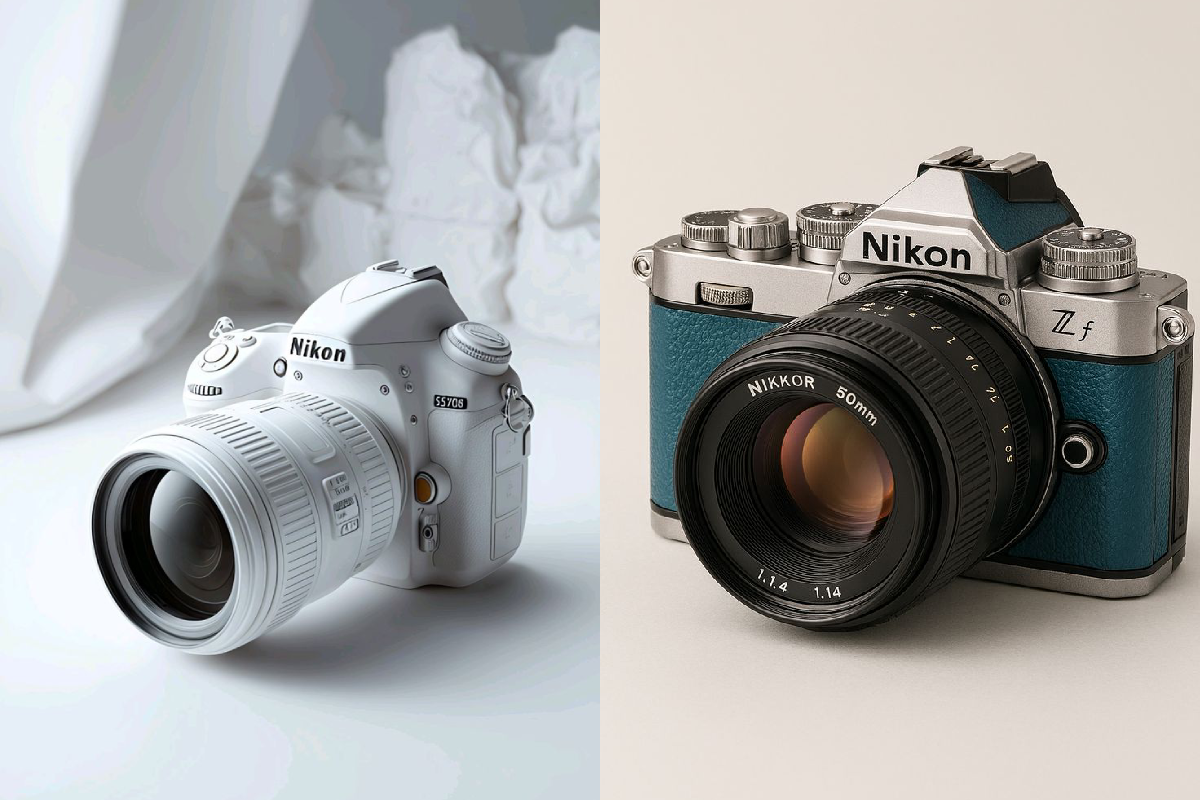
The visual featured here presents two very different interpretations of Nikon-inspired camera design: a clean, futuristic white body on one side and a retro-inspired blue-and-silver body on the other. Together, they create an interesting contrast between modern minimalism and classic photographic character.
Two Cameras, Two Design Languages
The most interesting aspect of the image is the contrast between the two cameras.
The white camera follows a contemporary aesthetic. Its monochromatic finish creates a clean, almost futuristic appearance, with the lens and body sharing the same bright colour palette.
The camera on the right takes a completely different direction. Its silver top plate, dark blue body and large black lens evoke the visual language of classic film-era cameras while incorporating a distinctly modern presentation.
It is a perfect example of how colour and materials can completely change the personality of a camera.
The Beauty of Retro-Inspired Design
The blue-and-silver camera immediately catches attention because of its vintage character.
The combination of a metallic-looking top plate, textured blue body and traditional physical dials creates a strong nostalgic impression.
Instead of hiding the controls, the design makes them visually prominent.
This approach appeals to photographers who appreciate the physical experience of using a camera—turning a dial, adjusting a setting and feeling the mechanical controls beneath their fingers.
Minimalism Takes the White Camera in Another Direction
The white camera creates an entirely different mood.
Its bright body and lens remove much of the visual complexity normally associated with professional camera equipment. Against the pale background, the camera almost becomes a sculptural object.
The design feels clean, contemporary and intentionally minimal.
This illustrates an important principle in industrial design:
Removing visual noise can make a familiar object feel completely new.
The Lens Becomes the Visual Anchor
In both compositions, the lens plays an important role.
The large circular form immediately draws the eye toward the centre of each camera. Glass elements inside the lens create subtle reflections, adding depth to the otherwise static product photographs.
On the darker camera, the black lens creates a strong contrast with the blue and silver body.
On the white camera, the lens blends into the monochromatic aesthetic while still retaining its visual importance.
Photography Equipment as Lifestyle Design
Cameras were once viewed almost entirely as technical equipment.
Today, their design can also communicate personal style.
A photographer may choose equipment not only for its capabilities but also for how it feels in the hand, how it looks in a studio and how it fits their creative identity.
This is particularly noticeable with cameras that combine modern technology with vintage-inspired aesthetics.
The object becomes part of the photographer’s visual world.
The Power of Physical Controls
The right-hand camera features prominent physical controls across its top plate.
These details immediately communicate a sense of craftsmanship and traditional camera design.
Modern cameras often rely heavily on menus and electronic interfaces, but physical dials provide a different experience. They make settings visible at a glance and contribute to the tactile character of the camera.
From a design perspective, these controls also add visual personality.
Blue, Silver and Black: A Timeless Combination
The colour palette of the right-hand camera is particularly effective.
Blue introduces personality.
Silver creates a connection with classic camera bodies.
Black provides contrast through the lens and controls.
Together, the three colours create a balanced composition that feels both nostalgic and contemporary.
White as a Statement
The all-white camera takes minimalism even further.
White has become increasingly associated with modern product design because it communicates cleanliness, simplicity and precision.
In photography equipment, it creates an unusual visual identity because traditional cameras are often dominated by black finishes.
The result is almost fashion-like.
The camera becomes something that could sit comfortably in a modern design studio as well as a photography workspace.
Product Photography That Lets Design Speak
The backgrounds in both images are intentionally simple.
There are no distracting environments or complicated props. This allows the camera bodies and lenses to dominate the frame.
Soft lighting reveals the contours of the equipment, while subtle shadows prevent the objects from appearing completely flat.
This is an effective product-photography approach because the viewer can concentrate on shape, colour, texture and construction.
The Future of Camera Design
Camera design continues to balance two competing ideas.
One is the future: lighter-looking bodies, modern materials and minimalist aesthetics.
The other is the past: physical controls, textured surfaces and designs inspired by classic cameras.
The two cameras in this visual represent those directions beautifully.
One looks toward the future.
The other celebrates the past.
Both demonstrate that camera design can be just as expressive as the photographs created with the equipment.
Final Thoughts
The real appeal of this visual isn’t simply the cameras themselves. It is the contrast between two design philosophies.
The white camera represents clean contemporary minimalism, while the blue-and-silver camera embraces retro-inspired photographic elegance.
Both approaches prove that a camera can be more than a technical tool.
It can be an object of design, a creative companion and even a reflection of the photographer’s personal style.
Because before a camera captures an image, its own design can already tell a story.

Comments are closed.