
Nothing Ear (note): AI Earbuds Turn Charging Case Into a Notetaker
Nothing is bringing AI-powered recording, meeting transcription and smart summaries to wireless earbuds. With physical TALK and RECORD buttons, the upcoming Ear (note) could change how people capture everyday conversations.

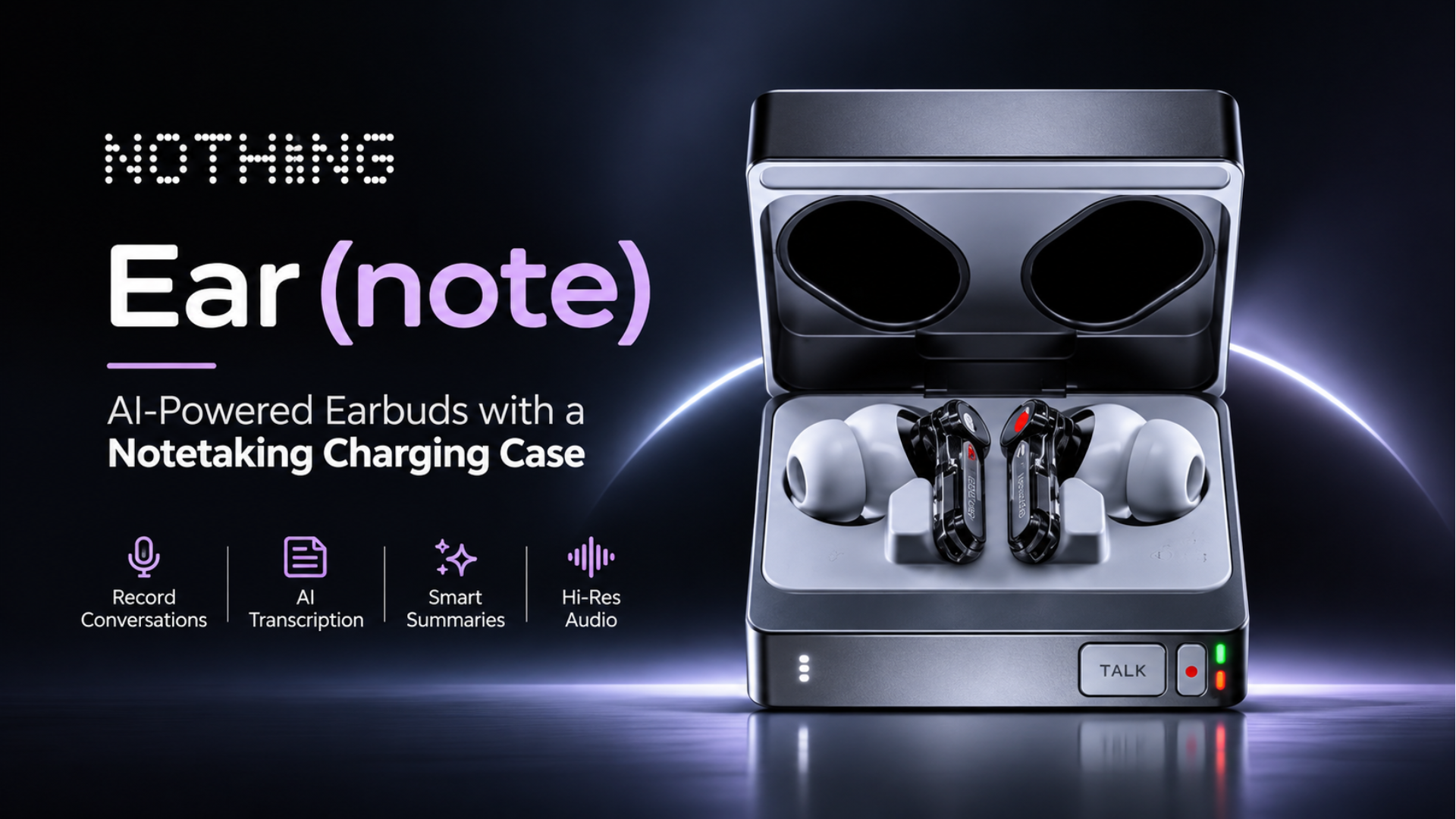
The charging case has always had a simple job: keep your earbuds safe and make sure they are ready for the next listening session. Nothing wants to give it a much bigger responsibility.
The idea is interesting. You could be listening to music one moment and capturing an important conversation the next, without reaching for your smartphone or carrying a separate recording gadget.
Nothing has scheduled the product launch for December 8, 2026. Pricing and detailed retail availability are still under wraps.
What Is Nothing Ear (note), and Why Is Everyone Talking About It?
Nothing Ear (note) is an upcoming pair of wireless earbuds designed around AI-powered audio recording and note-taking.
Unlike conventional earbuds that focus primarily on music, calls and noise cancellation, this product introduces another function: capturing conversations and turning them into useful information.
The concept has two recording sources:
-
The earbuds: Designed to capture phone calls and audio during conversations.
-
The charging case: Its built-in microphones are intended to record in-person discussions, meetings and spoken notes.
The recorded material can then be managed through a companion application, where users can access transcriptions and AI-generated summaries.
Nothing is positioning Ear (note) as its first AI-native device. That description reflects a shift in how the company wants its hardware to work, with AI becoming a central part of the product experience rather than an additional software feature.
According to reporting from The Verge and Bloomberg, Nothing CEO Carl Pei also sees the device as an early step towards a broader hardware context layer for AI.
The Backstory: Nothing Has Already Experimented With AI Recording
Nothing’s interest in recording features did not begin with Ear (note).
The company previously introduced the Super Mic feature with the Nothing Ear (3). The charging case included a microphone that users could activate through the TALK button and hold close to their mouths to capture their voice.
It was an interesting addition, but the experience raised questions about how practical a charging case could be as a dedicated microphone.
Ear (note) appears to take that experiment further.
Instead of treating recording as an occasional extra, Nothing is building the feature into the product’s central identity. The additional RECORD button also gives users a more direct way to start capturing conversations.
This distinction matters. People rarely want to interrupt a discussion to navigate multiple menus or open a separate recording application. A physical button could make the process considerably simpler.
What’s New? Nothing Ear (note) Design and Features Explained

1. A charging case that doubles as an AI recorder
The charging case is the biggest talking point.
Nothing has moved away from the familiar compact earbud-case design and introduced a more distinctive metallic, box-shaped appearance. Transparent sections offer a glimpse of the earbuds inside, while physical controls sit on the case.
The design gives the product a personality of its own. It also recalls older portable audio devices, particularly the physical controls found on classic Walkman-style players.
The case is expected to use its integrated microphones to capture in-person conversations and meetings.
2. Dedicated TALK and RECORD buttons

The two physical controls serve different purposes.
The TALK button builds on Nothing’s earlier Super Mic concept, while the new RECORD button is designed to initiate recording.
These tactile controls are a practical design decision. Users can start recording without searching through their phones for an application.
They may also make the recording process more transparent, although users will still need clear information about recording indicators, consent and privacy protections.
3. AI transcription and conversation summaries
Recording audio is only the first part of the experience.
The more interesting feature is what happens after a conversation ends. Nothing says Ear (note) will use AI to transcribe and summarise captured material.
Potential everyday uses include:
-
Turning business meetings into written notes.
-
Keeping track of important discussions.
-
Capturing personal reminders and ideas.
-
Reviewing conversations through searchable transcripts.
-
Identifying important points and follow-up actions.
The companion app is expected to manage recordings, transcripts and AI-generated summaries.
4. AI assistants could do more than summarise conversations
Nothing’s ambitions extend beyond producing a simple meeting summary.
Carl Pei has discussed the possibility of AI agents using captured context to draft documents, prepare emails and assign tasks.
Imagine finishing a client meeting and having an AI assistant prepare a summary of the discussion, list the agreed deadlines and draft a follow-up email.
That is the broader direction Nothing appears to be pursuing.
However, the complete AI workflow, supported assistants, software integrations and availability of individual features still need confirmation at launch.
5. Hi-Res Audio support
There is another important detail for people buying earbuds primarily for music.
Nothing has confirmed Hi-Res Audio support and says Ear (note) will deliver its best in-ear audio experience so far.
This suggests the company wants the product to appeal to regular music listeners as well as professionals interested in AI recording.
Full audio specifications, codec support, battery life and noise-cancellation details have yet to be established.
The Context Most AI Summaries Miss
The bigger story here is the changing relationship between AI and consumer hardware.
For years, AI features have largely lived inside smartphone applications and cloud-based services. Now, technology companies are experimenting with devices that can collect information from everyday activities and make that information useful through AI.
and client discussions.
But recording conversations also introduces privacy concerns.
Not everyone wants their discussions recorded, even when the intention is simply to create meeting notes. Users need clear recording indicators, appropriate consent mechanisms and transparent information about where recordings are stored and how AI services process them.
There are other practical questions, too.
Will transcription work reliably with Indian English and regional languages such as Tamil? Will the service require a subscription? Can users access transcripts without an internet connection? How accurately will the system distinguish between multiple speakers?
These details could have a significant impact on the product’s usefulness in India.
A clever recording case will attract attention. Reliable software, strong privacy controls and accurate transcription will determine whether people continue using it.
What Happens Next?
Nothing has scheduled the Ear (note) launch for December 8, 2026.
The company is expected to reveal the complete specifications, software capabilities and commercial details around the launch.
For Indian buyers, the major unanswered questions include:
-
What will the official India price be?
-
When will sales begin in India?
-
Will AI transcription support Indian languages?
-
Will users need a paid AI subscription?
-
Which third-party AI assistants will be supported?
-
How will Nothing handle recording consent and user data?
Until these details are confirmed, it is too early to judge the Ear (note) purely on its feature list.
Still, the product offers an interesting glimpse of where Nothing wants to take its hardware business.
The next generation of earbuds may have to do more than deliver good sound. They may also be expected to understand, remember and organise parts of our everyday lives.
And that is a much bigger proposition than another pair of wireless headphones.
Key Highlights
-
Nothing Ear (note) is the company’s first AI-native hardware product.
-
The charging case features dedicated TALK and RECORD buttons.
-
The earbuds are designed to record phone calls.
-
The case can capture in-person meetings and conversations.
-
AI features include transcription and conversation summaries.
-
Nothing has confirmed Hi-Res Audio support.
-
The official launch is scheduled for December 8, 2026.
-
Pricing and India availability remain unconfirmed.
“The next generation of earbuds may do more than play your favourite music. They could remember your meetings, organise your conversations and help turn everyday discussions into action.“
Frequently Asked Questions
1. What is Nothing Ear (note)?
Nothing Ear (note) is an upcoming pair of AI-powered wireless earbuds with a recording-enabled charging case. It is designed to capture phone calls and in-person conversations, generate transcripts and create AI-powered summaries through a companion application.
2. When will Nothing Ear (note) launch?
Nothing has scheduled the Ear (note) launch for December 8, 2026. The company has not yet confirmed its final pricing or specific retail availability in India.
3. Can Nothing Ear (note) record meetings?
Yes. Its charging case is designed with built-in microphones and a dedicated RECORD button for capturing in-person conversations and meetings. The earbuds are also designed to capture phone calls.
4. Does Nothing Ear (note) support AI transcription?
Yes. Nothing describes the product as an AI notetaker capable of transcribing and summarising conversations. The companion application is expected to manage recordings and provide AI-generated summaries.
5. What is the expected price of Nothing Ear (note) in India?
Nothing has not announced the official price of Ear (note). Its India pricing, sales date and availability are expected to become clearer around the December 8 launch.

Comments are closed.