

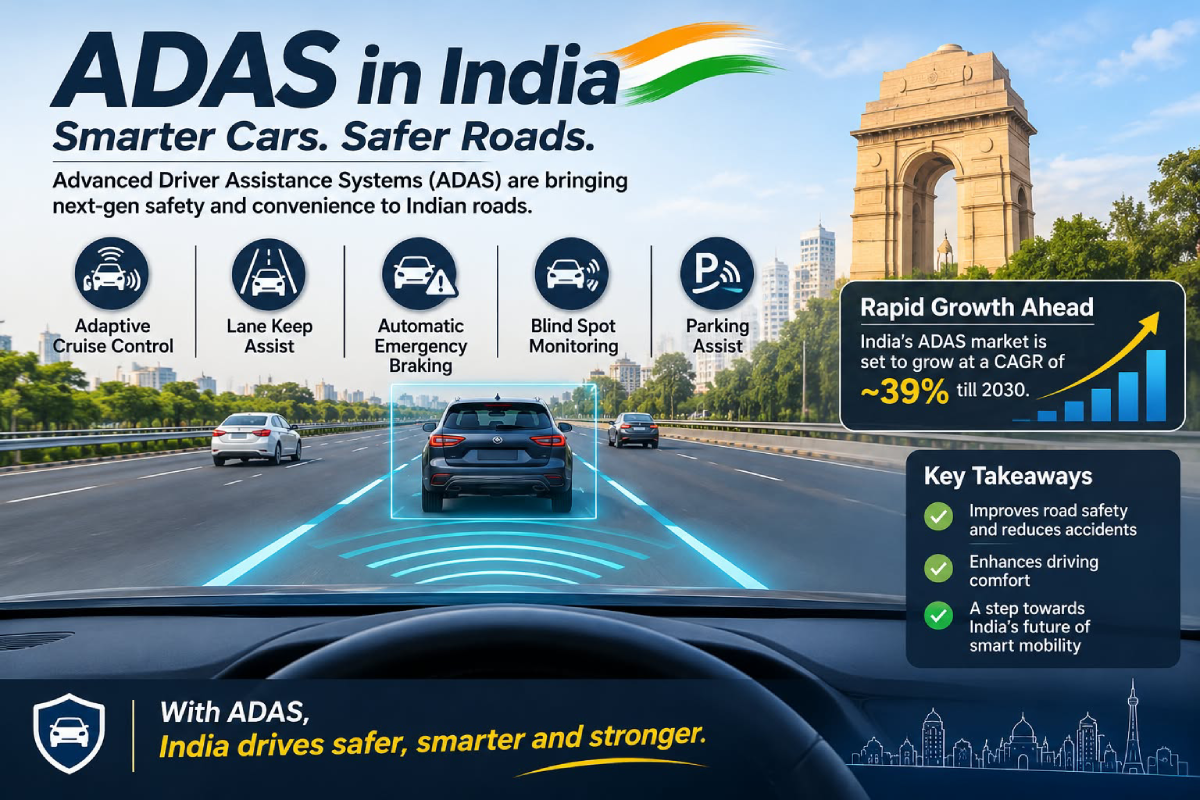
Advanced driver assistance systems, once reserved for expensive luxury cars, are now entering compact SUVs, hatchbacks and family cars in India. Features such as automatic emergency braking, lane-keeping assistance, blind-spot alerts and adaptive cruise control are becoming mainstream selling points.
But India is a difficult classroom for technology built around order. Our roads are a daily contest between buses, trucks, two-wheelers, auto-rickshaws, pedestrians, animals, potholes and unpredictable lane changes. The question is not whether ADAS is advanced—it is whether it can cope with Indian chaos.
What ADAS really does
ADAS does not make a car self-driving. It assists the driver. Adaptive cruise control maintains speed and distance, lane-keeping suppor…
“ADAS can watch the road, but only the driver can truly read India.”
FAQs
1. Does ADAS make a car self-driving?
No. ADAS assists the driver with warnings, braking, acceleration or steering support. The driver must remain alert and in control at all times.
2. Is ADAS useful in Indian city traffic?
Yes, but selectively. Features such as collision alerts, blind-spot monitoring and parking cameras can help, while lane-keeping and adaptive cruise control are more effective on well-marked highways.
3. Why does ADAS sometimes give false warnings in India?
Faded lane markings, dense traffic, sudden cut-ins by two-wheelers, pedestrians, animals, dust, rain and glare can confuse sensors and cameras.
4. Should I switch off ADAS if it beeps too much?
Not immediately. First check whether the sensors and camera are clean, and ask the dealership to explain or recalibrate the³ settings. Switching it off removes an important safety layer.
5. Is ADAS worth paying extra for in a mass-market car?
Yes, especially for features such as automatic emergency braking, blind-spot alerts and driver-monitoring systems. But buyers should ensure the system is properly demonstrated and suited to Indian road conditions.

Comments are closed.