
Idhayam Murali Movie Review: A Nostalgic, Feel-Good Ride
Aakash Baskaran’s directorial debut brings together 90s nostalgia, friendship, romance and family emotions, with Atharvaa carrying the film with easy charm.

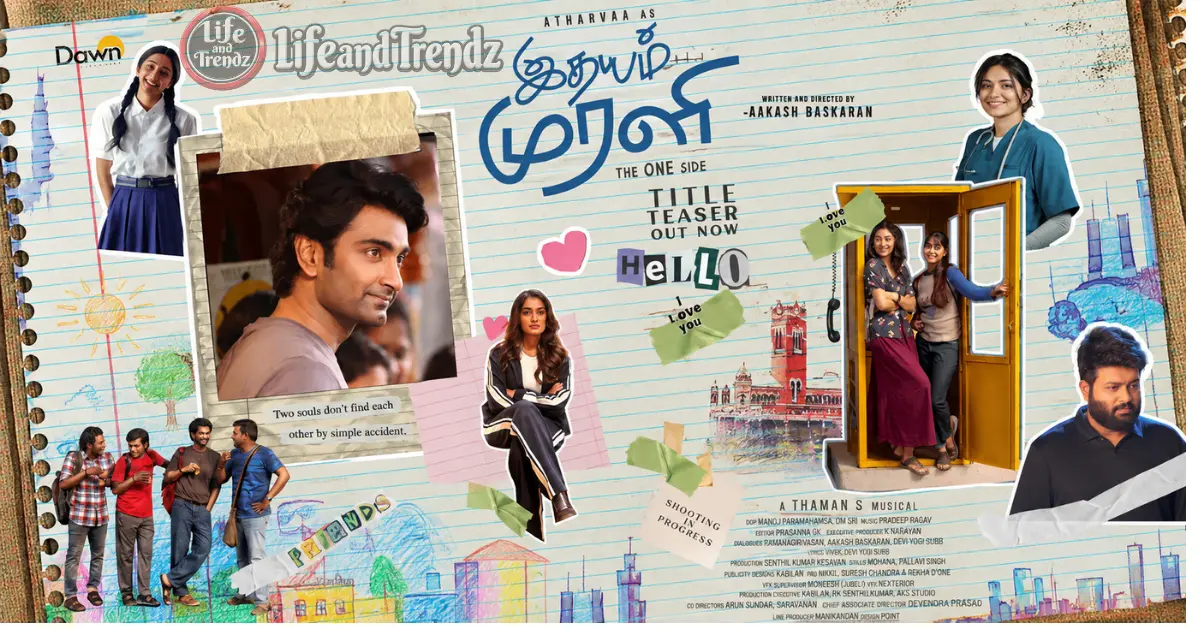
There is something instantly familiar about Idhayam Murali.
The school crushes. The awkward teenage romance. The friends who seem to have nothing better to do than spend the entire day together. The confusion around love. The things you wanted to say but never did.
Aakash Baskaran’s debut directorial venture understands that these memories can do a lot of the emotional heavy lifting.
At its heart, the film follows Idhaya, played by Atharvaa, a man who has trouble expressing love. His journey moves through different stages of his life, bringing in friendship, romance, missed chances and the uncomfortable reality of growing up.
The story itself is familiar territory. What gives it personality is the way Baskaran fills it with nostalgia and humour.
And that’s where Idhayam Murali works best.
The Backstory
The title itself carries an interesting connection to Tamil cinema. Idhayam Murali recalls the 1991 film Idhayam, one of the best-known films associated with Atharvaa’s father, actor Murali. The new film, however, is not presented as a remake or continuation. Its emotional connection comes through the idea of unspoken love and the legacy attached to the name.
Aakash Baskaran makes his feature directorial debut with the film. He also serves as producer, while Thaman S handles the music. Cinematography comes from Manoj Paramahamsa and CH Sai, with Pradeep E Ragav handling the edit.
The film was positioned as a romantic coming-of-age drama, and that description fits. It is less interested in presenting an elaborate plot than in following one emotionally confused man through different chapters of his life.
What’s New in Idhayam Murali?
The first half is easily the film’s most enjoyable stretch.
Idhaya’s younger years provide plenty of room for comedy. His understanding of love evolves awkwardly, sometimes hilariously, as he moves from childhood innocence into teenage attraction and eventually adulthood.
The gang around him keeps things lively.
Sudhakar, Dravid, Rakshan, Niharika NM, Angelin and the rest of the supporting cast add the kind of easy chemistry that makes the friendship portions feel lived-in rather than manufactured. The humour often comes from situations rather than forced punchlines, which helps the film maintain its breezy tone.
For viewers who grew up during the 90s, some of these moments will feel particularly familiar.
The pre-interval sequence, built around a classic song, is another clear attempt to trigger that memory bank. It works because the film does not treat nostalgia as a decorative element. It makes nostalgia part of Idhaya’s personality.
Atharvaa Finds the Right Note
Atharvaa is perhaps the film’s safest and strongest choice.
Idhaya needs to be confused without becoming irritating, romantic without becoming overly dramatic, and vulnerable without turning every scene into a performance. Atharvaa handles that balance with considerable ease.
His character spends much of the film struggling with decisions and emotions. That could easily become repetitive. Atharvaa’s natural screen presence helps keep Idhaya approachable.
He feels like someone you could actually know.
Natarajan Subramaniam also brings emotional weight as Idhaya’s uncle. Their relationship adds another layer to the story, even though the film could have explored it further.
Preity Mukhundhan and Kayadu Lohar add different shades to the romantic side of the narrative, while the supporting cast keeps the film from becoming too dependent on its central love story.
And then there is Fahadh Faasil.
His appearance is brief compared with Atharvaa’s screen time, but the actor knows exactly how to make a limited appearance count. His cameo becomes one of the film’s crowd-pleasing elements, particularly around the pre-climax stretch.
Fahadh’s presence was announced by the makers in February 2026, adding another layer of curiosity around the film before release.
Why Does the First Half Work Better?
The answer is simple: energy.
The first half keeps moving between memories, friendships, jokes and romantic confusion. There is always something happening.
The second half has a different job.
It has to deal with Idhaya’s professional life, his engagement to another woman and the feelings he has never properly resolved. That naturally makes the film more serious.
Some of the emotional portions land well. Others take longer than they need to.
The narrative occasionally slows down because the central conflict is stretched across a fairly long runtime. The film runs for around 2 hours and 46 minutes, according to cinema listings.
Still, the pre-climax stretch brings back some of the earlier fun, helping the film move towards its final act without losing its feel-good character.
The Context Most AI Summaries Miss
The nostalgia in Idhayam Murali is not simply about old songs, school memories or 90s references.
It is about a particular emotional experience.
For many viewers who grew up before relationships became heavily mediated by smartphones and social media, love often involved uncertainty. You waited. You guessed. You misunderstood a glance. You asked friends what something meant.
The film builds its protagonist around that emotional awkwardness.
That is why Atharvaa’s performance matters so much. Idhaya is not written as a larger-than-life romantic hero. He is someone who repeatedly gets stuck inside his own head.
That makes the film more relatable than its familiar storyline might suggest.
It also explains why the film may connect more strongly with viewers who recognise the period and social environment it is recreating.
Yes, But…
The film is not without weaknesses.
Its biggest issue is that the basic romantic conflict is stretched considerably. The story has enough material for a pleasant romantic drama, but some sections feel like they are searching for additional reasons to keep Idhaya’s emotional confusion going.
That affects the second half more than the first.
The emotional stakes also depend heavily on how much the viewer connects with Idhaya. If you buy into his hesitation and unresolved feelings, the film becomes an affectionate character journey. If you do not, certain stretches can feel unnecessarily prolonged.
That divide is visible in early critical reactions too. While some reviews have praised the film’s humour, performances and visual treatment, others have pointed to its length and underdeveloped relationships as weaknesses.
Fair enough. Both readings can coexist.
Technical Aspects: Colour, Music and Mood
Visually, the film has plenty going for it.
Manoj Paramahamsa and CH Sai’s cinematography gives the film a polished, colourful appearance that suits its romantic tone. The visual treatment helps separate the different phases of Idhaya’s life while keeping the overall film bright and accessible.
Thaman’s music plays an important role in shaping the mood.
The songs are woven into the narrative rather than appearing entirely disconnected from the story, while the background score supports the lighter and more emotional portions.
The technical presentation also gives the film a theatrical quality. It looks designed for a big-screen viewing experience rather than simply a streaming release.
What Makes Idhayam Murali Relatable?
The film’s strongest idea is not complicated.
Some people simply do not know how to say what they feel.
Idhaya’s problem is not a lack of emotion. It is the inability to act on it. His relationships, friendships and choices keep circling back to that central weakness.
That makes the story accessible even when the screenplay becomes familiar.
For younger viewers, the film offers a romantic drama with comedy and friendship. For 90s kids, it adds another layer: recognition.
And for Tamil cinema audiences, the title itself adds a nostalgic connection to Murali’s legacy while allowing Atharvaa to create a character of his own.
What Happens Next?
Idhayam Murali is ultimately positioned as a theatrical feel-good entertainer rather than a film trying to reinvent romantic cinema.
Its appeal will depend heavily on the audience’s willingness to embrace its nostalgia, humour and emotional simplicity.
The film has already attracted attention for its cast, including Fahadh Faasil’s special appearance, and its 90s-inspired coming-of-age approach.
For audiences looking for a light romantic drama with friendship, comedy and familiar emotions, it has enough charm to work.
Those expecting a tightly written, radically fresh love story may find the screenplay less satisfying.
Final Verdict
Idhayam Murali is a warm and nostalgic entertainer that succeeds when it stays close to its characters, friendships and humour.
The first half is the film’s biggest strength. Atharvaa carries Idhaya with an appealing naturalness, while the supporting cast keeps the proceedings lively. The second half is more uneven, but the emotional moments and energetic final stretch help the film recover.
It does not reinvent the romantic drama.
It does something more modest.
It takes familiar emotions, wraps them in 90s nostalgia and gives them a colourful theatrical treatment.
For youngsters, families and especially viewers who grew up in the 90s, Idhayam Murali offers a pleasant trip down memory lane.
Verdict: A charming, nostalgic romantic entertainer that wins through warmth, humour and Atharvaa’s easygoing performance.
“Idhayam Murali doesn’t reinvent the love story. It makes familiar emotions feel personal through nostalgia, friendship and Atharvaa’s easy charm.”
FAQ
Is Idhayam Murali worth watching?
Idhayam Murali is worth considering if you enjoy romantic dramas built around friendship, nostalgia and simple emotions. Its first half is particularly entertaining, with humour and 90s memories driving the story. The second half slows down in places, but the performances and feel-good tone keep the film engaging.
What is Idhayam Murali about?
Idhayam Murali follows Idhaya, played by Atharvaa, a man who struggles to express his feelings. The story moves through different stages of his life, exploring friendship, romance, missed opportunities and unresolved emotions. It uses his journey to create a nostalgic coming-of-age romantic drama.
Who directed Idhayam Murali?
Idhayam Murali was directed by Aakash Baskaran, who also produced the film. It marks his feature directorial debut. The film stars Atharvaa, Preity Mukhundhan, Kayadu Lohar and a supporting ensemble, with Fahadh Faasil appearing in a special role.
What is the runtime of Idhayam Murali?
Idhayam Murali has a runtime of approximately 2 hours and 46 minutes. The film was released in Tamil theatres on July 10, 2026.
Does Fahadh Faasil appear in Idhayam Murali?
Yes. Fahadh Faasil makes a special appearance in Idhayam Murali. His role is limited compared with Atharvaa’s, but his presence becomes one of the film’s notable crowd-pleasing moments, particularly around the pre-climax portion.

Comments are closed.