

There is a strange feeling that arrives before Jana Nayagan even begins.
You know this is a Vijay film. You also know it is supposed to be the last one.
That changes the way you watch almost everything.
The title card lands differently. The first Vijay elevation gets a bigger cheer. A familiar dance move gets applause before the song has even properly started. When the final moments arrive, the emotion is no longer limited to what H. Vinoth has written on screen.
It is about 33 years of memories.
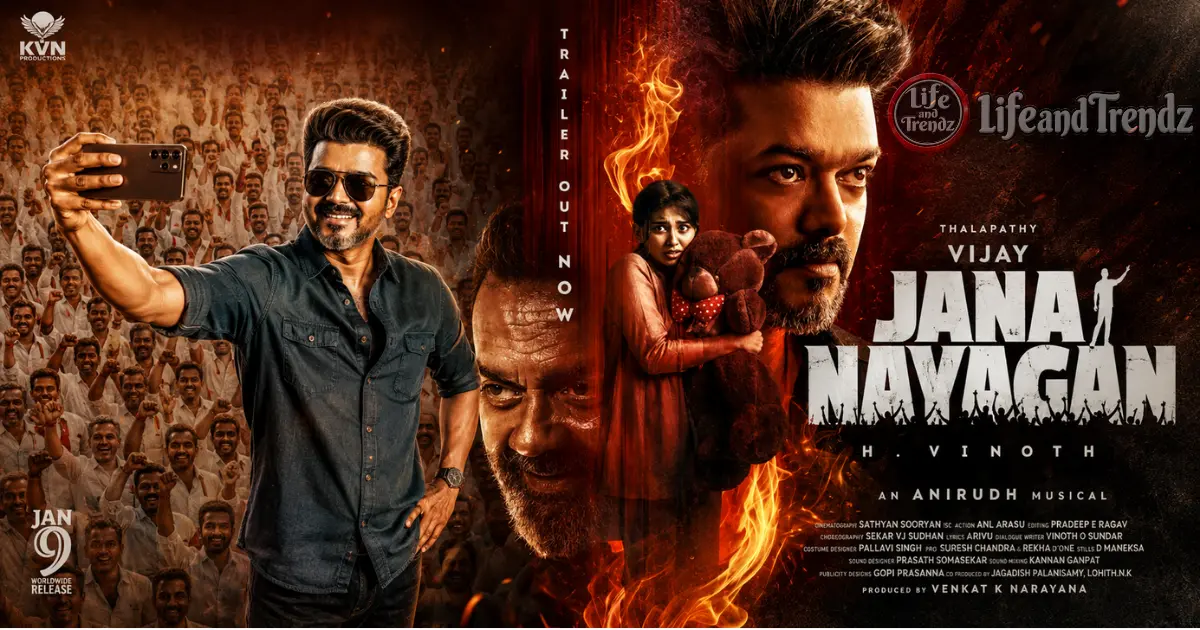
Vijay’s official film material describes Jana Nayagan as the culmination of a 69-film career and his final theatrical release. The film is directed by H. Vinoth, produced by KVN Productions and features an ensemble led by Vijay, Bobby Deol, Pooja Hegde and Mamitha Baiju.
Here’s the thing: Jana Nayagan knows exactly what its core audience wants.
It gives them plenty of it.
What Is Jana Nayagan About?
At its heart, Jana Nayagan follows Thalapathy Vetri Kondan, played by Vijay, and his relationship with Viji, played by Mamitha Baiju.
Vetri becomes a guardian figure in Viji’s life and encourages her to overcome fear and become an independent, strong woman. The personal story gradually expands into a much larger conflict involving Bobby Deol’s antagonist and a political struggle that brings together questions of power, corruption, democracy and social responsibility.
The film moves between personal emotion and large-scale action, eventually turning into a commercial political thriller with futuristic weapons, robots and elaborate action sequences.
That mixture is ambitious.
It is also where the film becomes somewhat overloaded.
The Backstory
Jana Nayagan arrived with extraordinary expectations.
Vijay had not appeared in a new theatrical release for roughly two years, and the film had become far bigger than an ordinary star vehicle. It was being discussed as his final film before his full-time political career. The production also faced a lengthy certification delay before finally reaching theatres on July 23.
That delay only made the anticipation stronger.
Advance bookings reflected the scale of that interest. Reports said Jana Nayagan crossed one million pre-sales on BookMyShow before release, giving Vijay a third consecutive one-million pre-sales milestone.
So when the film finally opened, audiences were not walking in simply to watch another H. Vinoth movie.
They were walking in to say goodbye.
What’s New?
H. Vinoth takes a familiar commercial template and reshapes it around Vijay’s screen image.
The film has clear echoes of Bhagavanth Kesari, particularly in its central guardian relationship and women empowerment thread. But Jana Nayagan adds political messaging, Vijay-specific fan service and a much wider conflict to the formula. Several critics have also pointed to the influence of the 2023 Telugu film.
The first half is generally more comfortable in its commercial zone.
Vijay’s relationship with Mamitha Baiju gives the film an emotional centre, while Bobby Deol’s presence gradually raises the stakes. The action, punch dialogues and elevation sequences are clearly calibrated for a theatre audience.
Mamitha Baiju is particularly effective.
Her scenes with Vijay provide some of the film’s more sincere moments, and she manages to hold attention even when the screenplay starts pushing the larger political material into the foreground.
Bobby Deol brings physical presence to the antagonist. His character is designed to feel threatening, although the writing does not always give him the depth that his screen presence deserves.
Pooja Hegde, Prakash Raj, Priyamani, Narain, Gautham Vasudev Menon, Revathy and Nassar add weight to the ensemble, even though several of their characters have limited room to develop.
Vijay Remains the Main Event
There is very little mystery about where the film’s energy comes from.
Vijay.
Whether he is delivering a punch dialogue, dancing, confronting the villain, walking into an action sequence or sharing an emotional moment with Mamitha Baiju, the film repeatedly returns to his charisma.
And the audience responds.
This is where Jana Nayagan works best. It understands the relationship between Vijay and his fans without pretending that relationship can be treated like an ordinary actor-audience equation.
The songs reinforce that feeling.
Anirudh Ravichander’s music gives the film several of its biggest theatrical moments, with tracks such as “Thalapathy Kacheri” already carrying enormous familiarity among fans. The song was released by T-Series and features vocals from Anirudh, Vijay and Arivu.
The background score also does plenty of heavy lifting, particularly during the action and fan-service sequences.
The Context Most AI Summaries Miss
A plot summary of Jana Nayagan can tell you what happens.
It cannot fully explain why the film feels different inside a Tamil cinema theatre.
This is a farewell movie.
That distinction matters.
Vijay’s career has been built on the mass entertainer format, but his relationship with audiences has changed over the years. His films have become events where fans celebrate songs, dialogues, gestures and references as much as the story itself.
Jana Nayagan deliberately embraces that history.
The film repeatedly reminds viewers of the Vijay they have watched for decades while also presenting a character associated with ideas of political leadership, social responsibility and public life. Critics have noted how closely the film’s political messaging is tied to Vijay’s transition from cinema into politics.
That is probably why the film can feel emotionally effective even when its screenplay becomes crowded.
The audience already knows the larger story.
This is the last Vijay film.
Yes, But…
The emotional significance of Jana Nayagan should not prevent a review from looking at the film itself.
The screenplay tries to carry too many ideas.
Women empowerment, child safety, political corruption, democracy, communal tensions, social responsibility and large-scale action all find their way into the narrative. Several reviews have noted that the film struggles to keep these themes together as one cohesive story.
The second half is where this becomes more noticeable.
The film expands dramatically, moving into a flashback involving Vijay and Bobby Deol before returning to a present-day conflict involving advanced technology and large-scale destruction.
Some action blocks deliver the expected whistles.
Others feel stretched.
The VFX-driven portions are also likely to divide viewers, particularly those expecting a more grounded H. Vinoth treatment.
That said, the film rarely forgets its primary purpose.
This is Vijay’s farewell.
What Happens Next?
For Vijay, the bigger transition is now outside cinema.
Jana Nayagan closes a 33-year acting journey that spans 69 films, while his public life has moved increasingly towards politics. The film itself reflects that transition through its political themes and the image of Vijay as a leader addressing public concerns.
For audiences, the next chapter is simpler.
There will be no waiting for the next Vijay theatrical release.
No first-look announcement.
No teaser celebration.
No midnight countdown for a new Vijay film.
That reality gives Jana Nayagan a weight that the screenplay itself cannot always create.
The Verdict
Can Jana Nayagan be described as a flawless Vijay film?
No.
Does every subplot work?
No.
Does the film occasionally become too crowded with messages, political ideas and action?
Yes.
But that is only part of the conversation.
As a farewell to Vijay on the big screen, Jana Nayagan understands the assignment. It gives fans the songs, action, emotion, punch dialogues, dance, nostalgia and larger-than-life moments they came expecting.
Vijay carries the film with the ease of a performer who has spent decades understanding exactly what his audience wants.
Mamitha Baiju provides the strongest emotional support. Bobby Deol brings menace where the screenplay allows him to. Anirudh’s music keeps the energy high. Sathyan Sooryan’s cinematography gives the film scale, while Anl Arasu’s action choreography delivers several sequences designed for the whistle-happy crowd.
And then comes the uncomfortable part.
There is no next Vijay film.
That thought will probably stay with audiences longer than any individual action sequence.
So, if you are looking for a tightly constructed political thriller, Jana Nayagan may test your patience.
If you are going to the theatre to experience Vijay’s final big-screen celebration with family, friends and thousands of other fans, the film offers plenty to cheer for.
Jana Nayagan is, above all, a quintessential Thalapathy Vijay farewell.
Just one final theatrical celebration for a star who has spent more than three decades creating memories.
“Jana Nayagan may not be Vijay’s most tightly written film, but it understands one thing perfectly: his final theatrical appearance had to feel like a celebration.”
FAQ
Is Jana Nayagan Vijay’s final movie?
Yes. Jana Nayagan is positioned as Vijay’s final theatrical film before his full-time transition into politics. The film marks the end of a 69-film, roughly 33-year cinematic journey.
Who directed Jana Nayagan?
Jana Nayagan was written and directed by H. Vinoth, who is known for films including Theeran Adhigaaram Ondru, Nerkonda Paarvai, Valimai and Thunivu.
Who plays the female lead in Jana Nayagan?
Pooja Hegde plays Kayal, while Mamitha Baiju plays Viji, a central character whose relationship with Vijay’s Vetri Kondan forms an important emotional thread in the film.
What is Jana Nayagan about?
The film follows Vijay’s Thalapathy Vetri Kondan as he becomes a guardian figure to Viji, played by Mamitha Baiju. Their personal story expands into a larger conflict involving political power, social issues and Bobby Deol’s antagonist.
Is Jana Nayagan worth watching in theatres?
For Vijay fans, the theatrical experience is the film’s biggest attraction. The movie delivers songs, action, emotional moments, punch dialogues and extensive fan service. Viewers looking primarily for a tightly structured political thriller may find the screenplay uneven, particularly in the second half.

Comments are closed.